

The right chef knife is your greatest assistant in the kitchen.
For a chef, a knife is not merely a piece of kitchen equipment. A knife means speed, technical control, safety and sometimes even reflects the character of a chef. In professional kitchens, the knife is the tool most closely integrated with a chef’s hand. That is why choosing the right chef knife directly affects performance in the kitchen.
Today, many people ask questions such as “how do you choose a chef knife?”, “what size should a chef knife be?” or “which knives do chefs use?” In reality, there is no single answer. The right knife depends on hand structure, working habits and what you cook in the kitchen.
For me, a good chef knife is one that feels natural in the hand and does not tire you while working.
The History of Chef Knives
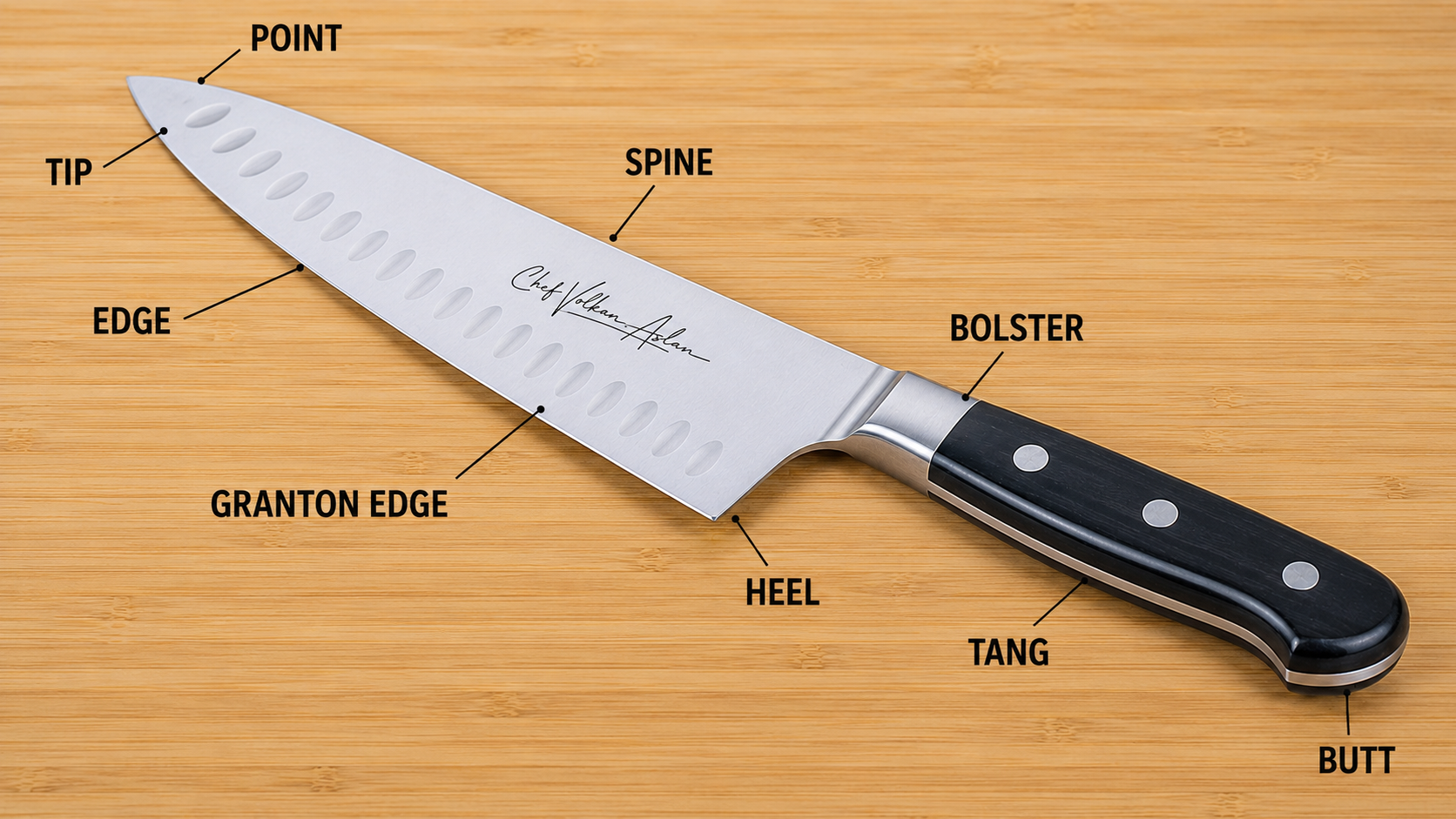
The main parts of a professional chef knife — the cutting edge, spine, bolster, heel and handle structure — directly affect balance, cutting control and kitchen performance.
The history of chef knives goes back centuries. In European cuisine, especially German and French knives developed around durability and versatile use, while in Japanese cuisine, knives capable of thinner and more precise cuts came to the forefront.
Among the chef knife types most commonly used in professional kitchens today are:
- Classic French chef knife
- Heavy German-style chef knives
- Japanese Santoku knives
- Gyuto
- Deba
- Slicing knives
Japanese chef knives have become especially popular in global gastronomy in recent years. Their thin edge structure allows for highly precise cuts.
What Is a Chef Knife Used For?
A good chef knife can perform many tasks on its own in the kitchen. With a professional chef knife, you can chop vegetables, slice meat, cut herbs, clean fish, finely cut sauce ingredients and prepare delicate presentation work.
However, the important point is this: using one knife for every task is not always correct. For example, bone-in meats require a stronger knife structure, while fine vegetable cuts call for a more delicate edge.
That is why professional chefs gradually build their own knife set for chefs over time.
How to Choose a Chef Knife
It is not possible to understand whether a knife is good only by looking at it. What matters is how it feels in the hand during long use. There are several key points to consider when choosing a chef knife.
Knife Balance A good knife should be neither too heavy nor too light. It should feel balanced in the hand. A well-balanced knife reduces hand fatigue during long service hours.
Handle Structure The handle should sit comfortably in the palm. Ergonomics are extremely important for chefs who work for long hours. The handle should not slip, should support the natural movement of the hand and should not strain the wrist.
Steel Quality The steel used in a chef knife is as important as its sharpness. Stainless steels provide durability, while high-carbon steels can stay sharp for longer.
Today, Damascus steel, N690 steel and high-carbon steels are frequently preferred in professional kitchens.
Knife Length The question “what size should a chef knife be?” is asked very often. In general, 16 cm may be suitable for home kitchens, 18–20 cm for professional use, and 24 cm or above for large kitchen operations. In professional kitchens, the most balanced use is generally seen with 20 cm chef knives.
How Do Chefs Hold a Knife?
Proper knife grip is very important in professional kitchens. Most chefs use a technique called the pinch grip. In this method, the thumb and index finger grip the steel part of the knife.
This technique provides more controlled cutting, improves safety, increases speed and reduces hand fatigue. Especially in high-volume service kitchens, correct grip technique makes a significant difference.
Why Is Cutting Board Selection Important?
Many people invest only in the knife and overlook the importance of the cutting board. However, the wrong cutting board can quickly dull even a very high-quality knife.
Knife-friendly cutting boards include:
- Wooden boards
- Natural bamboo boards
- High-quality professional kitchen plastic boards
Glass, marble or ceramic surfaces can seriously damage the knife edge. The greatest enemy of a sharp knife is the wrong surface.
How Should a Chef Knife Be Maintained?
Knife care is very important in a professional kitchen. To use a good knife for many years with the same performance, proper care habits must be established.
- Knives should not be put in the dishwasher
- They should be washed by hand and dried immediately after use
- They should not be left damp
- They should be stored on a magnetic rack or in a protective sheath
- A honing steel should be used regularly
- Professional sharpening should be done periodically
The question “how do you sharpen a chef knife?” also becomes important here. Sharpening at the wrong angle can damage the cutting form of the blade. For this reason, professional sharpening equipment should be used.
Every Chef Has a Different Preference
There are many different chef knife brands on the market today. Some chefs prefer heavy German-style knives, while others prefer lighter Japanese chef knives. The important point is not the brand; it is how well the knife fits your hand.
Because the best knife in the kitchen is the one that makes the chef’s movement feel natural.
A good chef first respects the knife.
A correctly chosen chef knife helps you work more safely, delivers cleaner cuts, protects the structure of the product, increases working speed and provides comfort during long use.
In a professional kitchen, mastery reveals itself not only on the plate, but also in the way the knife is used.
Chef Volkan Aslan